
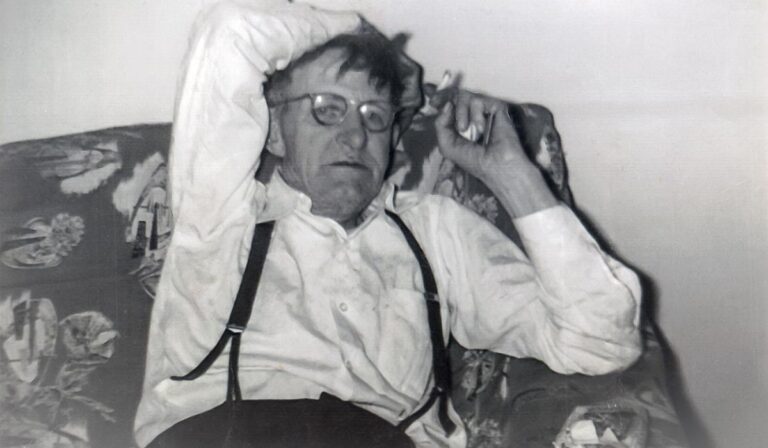
On my last trip to New York, I visited a family member whom I hadn’t seen in a long time. Before I left, she handed me a photograph of her grandfather, Poppy—my great-grandfather, James Joseph McKnight. I thought it would be a good opportunity to share it and write a little about him.
Although I didn’t know him personally, the family remembers Poppy as a kind, generous, and deeply devoted family man. When times were tough, he made sure my father and his siblings never went hungry, sometimes buying loads of potatoes—fifty to a hundred pounds at a time—to get them through.1 His granddaughter remembers how he bought her new clothes for school.2 Every once in a while, he gave her money for the movies, and on at least one occasion, borrowed it from his boss.3 It was a gesture that seemed ordinary as a child, but was later met with deep gratitude and appreciation.
Brooklyn Beginnings and The Cedars
James Joseph McKnight was born on 13 February 1884 in Brooklyn, New York, the first of six children of Frank M. and Catherine (McDonald) McKnight.4 By 1900, the family was living at The Cedars, a small hamlet of about twenty-five families near Shell Bank, just across a footbridge from Sheepshead Bay.5 Other familiar families in the area included the Daltons and the Knuths.6 Frank and Catherine’s descendants made The Cedars their home.
Family Man
Like his father, James earned a living as a lather and carpenter, a trade that would later support his family.7 Marriage and children soon followed.
He married Matilda Goettisheim on 21 May 1910 at St. Mark’s Church in Brooklyn.8 Matilda, also known as “Tillie,” was the daughter of German immigrants, Paul Goettisheim and Elizabeth Kirchberger, and grew up at West Meadow Bank in Gravesend.9 Matilda was only about seventeen years old when she married James, who was twenty-six.10 Together, the couple raised six children: Elizabeth, Frank, Donald, Marie, Catherine, and my grandmother, Dorothy.
James worked for a while as a carpenter for Vitagraph Studios on East 14th Street and Avenue M.11 Vitagraph was a pioneering film studio and a leader in the silent film industry in the early 20th century. His sisters, Ann and Mary, worked there as film cutters, one of whom was also a pioneer in the industry.12
Tragically, Matilda died of cancer on 19 August 1931, at just thirty-eight years old.13 By this time, the three eldest children were adults. After her death, James probably felt he needed help raising his three young daughters. My grandmother Dorothy and her sisters were split up and lived in different households.14 According to the family, Dorothy lived with James’s sisters, Nonnie (Elizabeth McKnight) and Bun (Ann McKnight), and she also lived with her older sister, Elizabeth Miller.15 That said, Ann, who became the first female film cutter, lived in Los Angeles from at least 1930 to 1940.16 Even so, she played an important role in Dorothy’s life. James didn’t go anywhere; he was nearby. The family stayed close, living in Sheepshead Bay and stepping in to help when needed. As they say, it takes a village.
Stepping Up
Although James’s nephew Albert Quick lived with his grandparents, Frank and Catherine McKnight, for most of his childhood, my uncle said that James played an active role in his life.17 After Frank and Catherine passed away, James stepped in fully, raising Albert as if he were one of his own.18 Albert and my grandmother, Dorothy, remained very close; she thought of him more like a brother.19
Life on Coyle Street
By 1935, James was living at 2618 Coyle Street.20 This is the house where my father and his siblings grew up. Relatives say that he co-owned the house with my grandparents, Carlton and Dorothy Hendrickson.21 When they married in 1939, they likely acquired a share of the property, although that could have happened later. According to the 1940 census, my grandparents lived in the family home while James lived a few doors down at 2540 Coyle Street.22 By 1942, he returned to 2618 Coyle Street.23
The house was in terrible condition and had no heat; a potbelly stove provided the only warmth.24 His granddaughter got up early each morning to start the fire, while Poppy slept at the other end of the room.25 He appreciated having it ready before he got up.26 That potbelly stove was the cause of a fire that erupted one morning while James was alone in the house.27 Whitey, the family dog, woke him just in time, allowing him to escape unharmed.28
Poppy Remembered
In his later years, James worked at Mike’s Tackle Shop on Emmons Avenue.29 He didn’t own a car and walked everywhere, moving easily between home, family, and work.30
He was a smoker, rolling his own cigarettes with Ivanhoe, Bugler, and Half and Half pipe tobacco.31 His granddaughter remembers visiting the park to play handball when her friends convinced her to smoke.32 Poppy, who was walking by, caught her red-handed.33 He didn’t scold—he simply asked, “What are you doing?”34 It was a moment she never forgot. It makes me wonder if he asked the question with a cigarette between his fingers.
Although he never remarried, he reportedly had a girlfriend later in life—Alice Dwyer, a seamstress who sometimes visited the house. 35
Later Years
James lived with my grandparents for over twenty years.36 In the early 1960s, following an argument about my grandfather’s drinking and gambling, he moved in with his daughter Elizabeth and her husband, Joe Miller.37 Poppy died on 2 October 1961, at his home on 3029 Emmons Avenue, and is buried at Holy Cross Cemetery in Brooklyn.38
The stories about Poppy left a lasting impression and brought me closer to a man I never knew. Records help us understand our ancestors by putting them in a time and place, but genealogy is more than just names and dates. It’s about preserving memories, reflections, and the little details that give a person life. What started as a photograph of Poppy grew into a clearer picture of a man who could fill a house with enough potatoes to feed an army—and a heart big enough to match.